Showing posts with label Homestead. Show all posts

Tuesday, August 21, 2012

Thicket Mapping at Homestead National Monument

2012 Homestead National Monument Thicket Map
Homestead National Monument of America was established to tell the story of  the Homestead Act. While the monument tells the story of homesteaders, they also strive to show to visitors what the tall grass prairie would have looked like to those original homesteaders. Therefor the monument has over the last decade began to monitor and remove woody species that would not have been in the tall grass prairie of the past. Smooth Sumac (Rhus) covers almost 24 acres of the 120 acres of tall grass prairie. Dogwood (Cornus) is the other big issue species. Plum (Prunus), Ash (Fraxinus) and Elderberry (Sambucus) are also present as thickets. There are also a small umber of trees such as Eastern Cedar, some other deciduous trees and quite a few Honeylocust. The numbers that are in the key, 1-4 refer to the density of each thicket. Thickets rated a with a number 1 are the thickest and 4 are the thinnest. At present 34 acres of the prairie are currently covered by thicket. Mapping has been done about 5 times in the last 10 years. This year I was the one that did all of the mapping. I used a Trimble GPS with an external antenna attached to a back pack I wore. I had to identify  thicket species and density and then walk around the perimeter of each thicket. The data was then downloaded and Natural Resource Specialist Jess Bolli made the map that is at the beginning of this blog. Once the location and density of the thickets is recorded, treatment and removal can begin. Numerous different treatment methods have been tried including foliage treatment with different chemicals and also the cut and spray  treatment method. Much thought is put into choosing chemicals and treatment methods. The monument wants to control the amount of tickets present on the prairie while causing no harm to wildlife or desirable native plants. For this season, both foliage and cut and spray methods are being employed. So, for any of you that have visited the prairie, all of the red areas are dogwood and sumac thickets that have been treated by chemicals applied to the foliage. Starting this week I will be out in the prairie beginning with cut and spray treatment of some of the thinner thickets. Hopefully the treatment this year will stop the spread of the thickets and perhaps it will even begin to shrink the size of the thickets. Homestead National Monument is committed to showing all its visitors what the tall grass prairie would have looked like to the homesteaders just arriving in the area.

Monday, August 20, 2012

More on Soundscape

Basically the efforts of the listening center results in a few different graphics once I run the data through the 'R' program. I find that the bar graph is the most understandable. The listening center, I analyze 8 days for every site, and each day is split into 10 seconds for every 2 minutes. This comes down to 2 hours worth of data that I listen to. Every sound I hear has a code that I enter, like 2.4 is a truck, 9.1 is a domestic dog or 23 for thunder. When I run the results through the AMT program I can chose any code that I want highlighted on the graph. Right now I have run the program to highlight all vehicle sounds as compared to all audible noises. The nice thing about the resulting graph is that is is easy to compare different seasons at one site or to compare the same seasons at the same site. The graphs that I have included are for the same site but at different seasons. You can see that traffic is audible for a higher percentage of time than in the summer, I am going to assume that the lack of foliage in winter is what has resulted in this difference. 


As you can guess being able to run this graph for almost any possible noise, man made and natural, can be both interesting and informative. The information in these graphs and in the other soundscape data can allow parks to establish base line acoustical data and allow them to make informed management decisions. Some parks like Zion have soundscape management plans, the Grand Canyon used the information to help develop air tour management plans and Yellowstone used soundscape information in their winter use plan. I encourage you to visit the NPS Natural Sounds and Night Skies website if you are interested in more information about soundscape.

Sunday, July 22, 2012

Animals of the Tall Grass Prairie


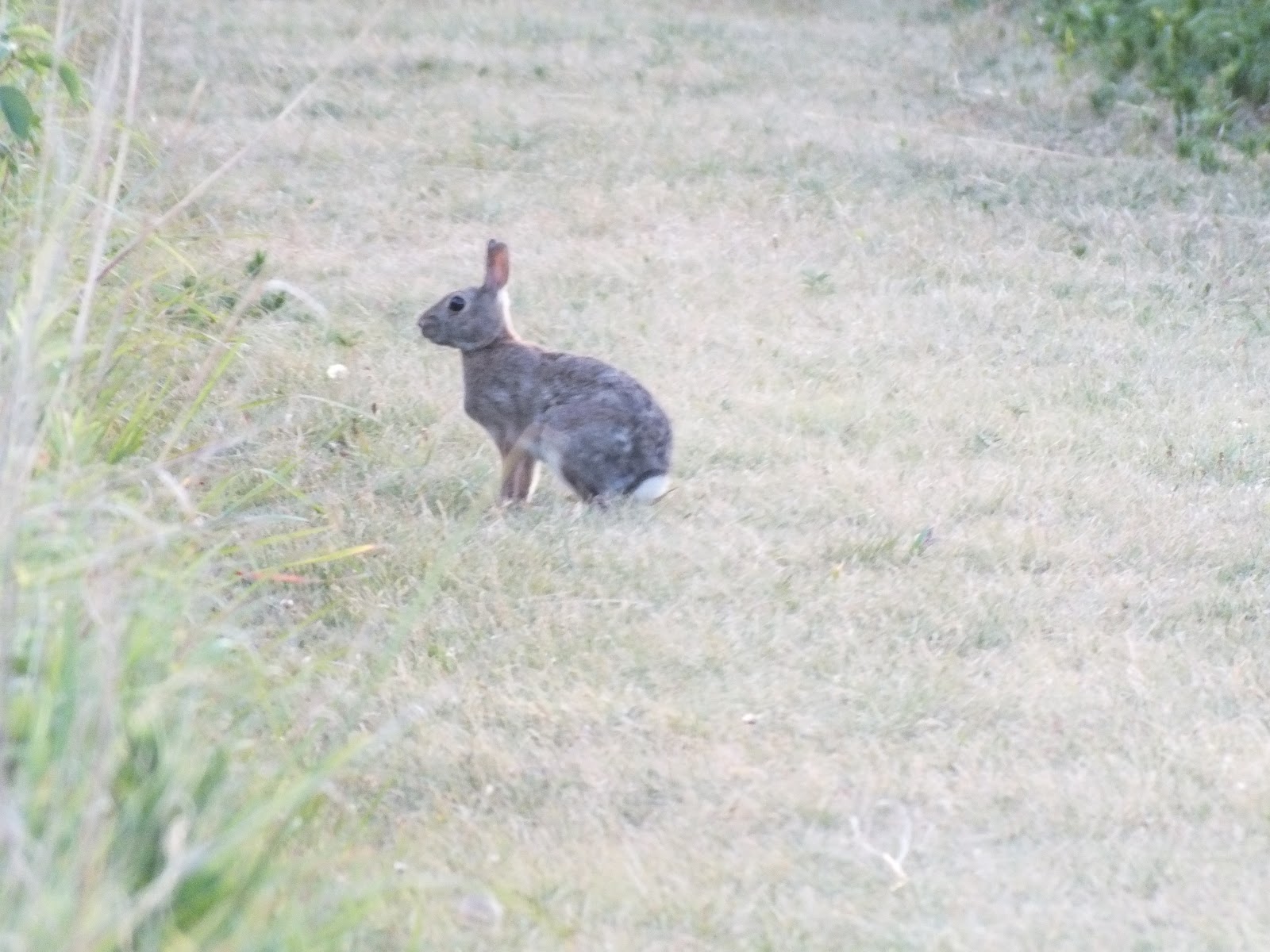
Eastern Cottontail
As I am sure you can imagine, there are many animals that live in the tall grass prairie and the surrounding woodlands. I have gotten pictures of some, while others are a bit more illusive, though I still hope to snap a pic at some point in the season! One of the first pictures I got was of an eastern cottontail, though the first animals I saw were white-tail deer, thirteen line ground squirrels, and many types of birds, of which I have not been able to get pictures yet. I had the chance to help my supervisor in the Heartland Monitoring Network Bird Survey program. The survey basically had my supervisor and I out on the prairie and in the woodlands of the monument within the first 4 hours of sunlight during early June. We visited approximately 45 GPS location, that were established for specifically for this program. At each location we would record each species of bird that we saw or heard during a five minute period. We observed or heard many species of birds including, but not limited to: Indigo Bunting, Great Blue Heron, American Robin, American Crow, American Goldfinch, Eastern Phoebe, Northern Bobwhite, Spotted Towhee, Blue Jay, White Breasted Nuthatch, Red-Bellied Woodpecker, Eastern Wood-Pewee, Ring-necked Pheasant, Northern Cardinal, Barn Swallow, Red-winged Blackbird, Grey Catbird, Mourning Dove, House Wren, Norther Flicker (Yellow Shafted), Rose breasted Grosbeak, Baltimore Oriole, Turkey Vulture, Eastern Kingbird, Brown-headed Cowbird, Eastern Bluebird, Warbling Vireo and Killdeer. Outside of the survey I have seen/heard wild turkey, Downy woodpeckers, Hairy woodpeckers, Red-headed woodpeckers and Barred Owls. However here are some of the pictures that I have been able to get:
 Eastern Comma Butterfly (Lepidoptera)
Crazy Fox Squirrel licking the pavement
Fresh Water Mussel in Cub Creek
Female Red-winged Black bird
American Goldfinch- male
Solider Beetle (Coleoptera) on a Milkweed plant
Dickcissel
Baltimore Oriole feeding the family
Phoebe feeding the family
American Carrion Beetle (Coleoptera)
Baby spiders
Juvenile Robins

There are many other interesting animals on the prairie, my roommate and fellow SCA intern Chelsea saw a mink and a beaver, which I have yet to see. I have had the opportunity to see many fledglings, mostly robin, barn swallow and phoebe. I also got to see a coyote cross the road while I was driving to Kansas. I have also been able to see what lives in Cub Creek, we have found some small fish, probably in the minnow family, crayfish and many interesting macroinverterbrates.  I hope to see many more animals and I hope to get more pictures too, so that I can share them with you!